

Cameras don’t create evidence. Operations do.
A video system is only useful if footage can be found, verified, exported, and delivered when an incident occurs. Recording is the beginning, not the finish line.
The P.R.O.T.E.C.T. Report reviews whether video systems are operationally ready, not just installed.
The camera is only the start. The outcome is usable evidence.
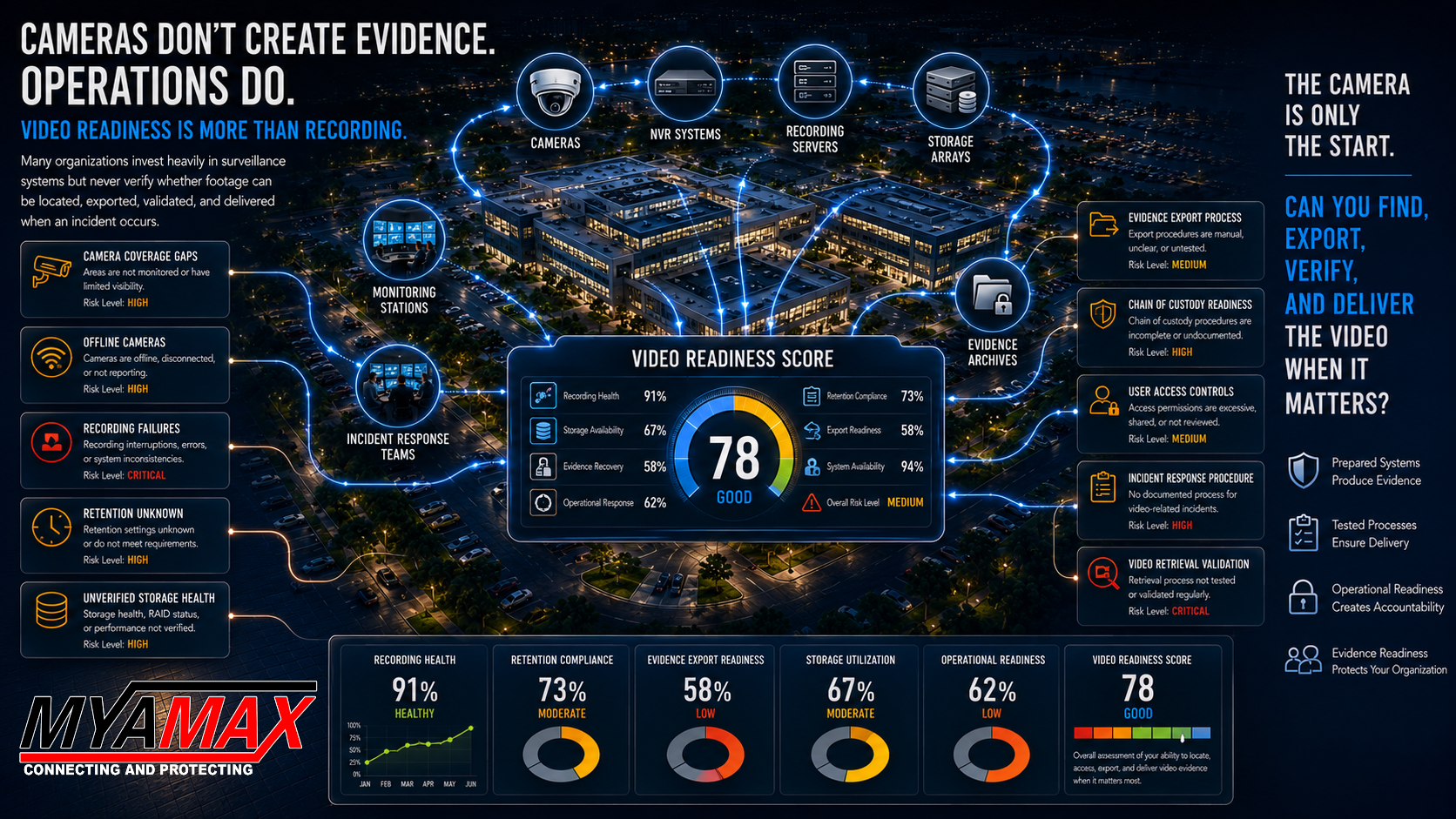
Seeing cameras online does not prove the system is ready.
Many organizations can open a video app and see live cameras. That does not confirm video system operational readiness.
Readiness includes coverage, recording health, retention, playback, exports, user permissions, storage condition, system ownership, staff training, and incident response procedures.
Common discovery moment
“We saw the incident on camera, but nobody knew how to find the clip, export it correctly, prove retention, or deliver it in usable form.”
The P.R.O.T.E.C.T. Report reviews the operational side of surveillance.
Camera Coverage
Field of view, blind spots, critical areas, lighting conditions, identification range, and coverage gaps.
Recording Health
Recording status, schedules, stream quality, storage condition, failed channels, and verification procedures.
Video Retention
Retention days, overwrite behavior, storage allocation, policy alignment, and evidence preservation expectations.
Evidence Export
Export workflow, file format, viewer compatibility, export permissions, and delivery readiness.
User Permissions
Who can view, search, export, delete, administer, or remotely access video systems.
Incident Response
Whether staff know what to do when video is needed after a theft, injury, dispute, damage event, or police request.
How cameras become evidence.
Capture
Cameras must cover the correct area with usable lighting, angle, and detail.
Record
The system must reliably store footage for the required retention period.
Retrieve
Authorized users must be able to locate the correct footage quickly.
Deliver
Evidence must be exported, verified, and shared in usable form.
From installed cameras to documented readiness gaps.
Recording Verification Not Performed
Live camera views are available, but recording status, retention, export workflow, and playback reliability have not been verified.
Recommended action: perform recording verification and document export procedures.
Evidence Export Process Unknown
Staff could not demonstrate a repeatable process for locating, exporting, validating, and delivering video evidence.
Recommended action: train authorized users and create a video evidence procedure.
Retention Policy Unclear
Actual retention period does not appear to be documented or aligned with business, insurance, or operational expectations.
Recommended action: validate storage, retention settings, and overwrite behavior.
User Permissions Need Review
Video viewing, export, administrative, and remote access permissions may not reflect current roles or least-privilege needs.
Recommended action: review user permissions and remove stale access.
Video systems should be tested before an incident forces the question.
A camera system can look impressive and still fail during investigation if footage is missing, too short, inaccessible, poorly exported, or controlled by the wrong users.
MYAMAX helps organizations evaluate whether video systems support real-world operations, not just visual coverage.
Simple questions reveal whether video is truly usable.
Surveillance value is proven after something happens.
The value of a camera system is not proven by the number of cameras installed. It is proven when footage can be located, verified, exported, and used when the organization needs it.
The P.R.O.T.E.C.T. Report helps separate camera presence from evidence readiness.
Core principle
Visibility is not verification. A live camera view is not proof of evidence readiness.
Video readiness connects to telemetry, ownership, vendors, and continuity.
Request a complimentary P.R.O.T.E.C.T. Report assessment.
MYAMAX helps commercial properties identify video system readiness gaps, recording uncertainty, retention issues, user permission risks, and evidence export concerns.
1-888-MYAMAX-0 / 1-888-692-6290