Vendor dependency is a hidden operational risk.
Most organizations think vendor risk starts with price. In reality, it often starts with access, documentation, cloud ownership, licensing, recovery paths, and the knowledge only one vendor controls.
The P.R.O.T.E.C.T. Report helps identify where commercial systems are dependent on people, companies, platforms, contracts, credentials, or undocumented configuration.
The question is not whether your vendor is good. The question is whether your organization can still operate if that vendor is unavailable.
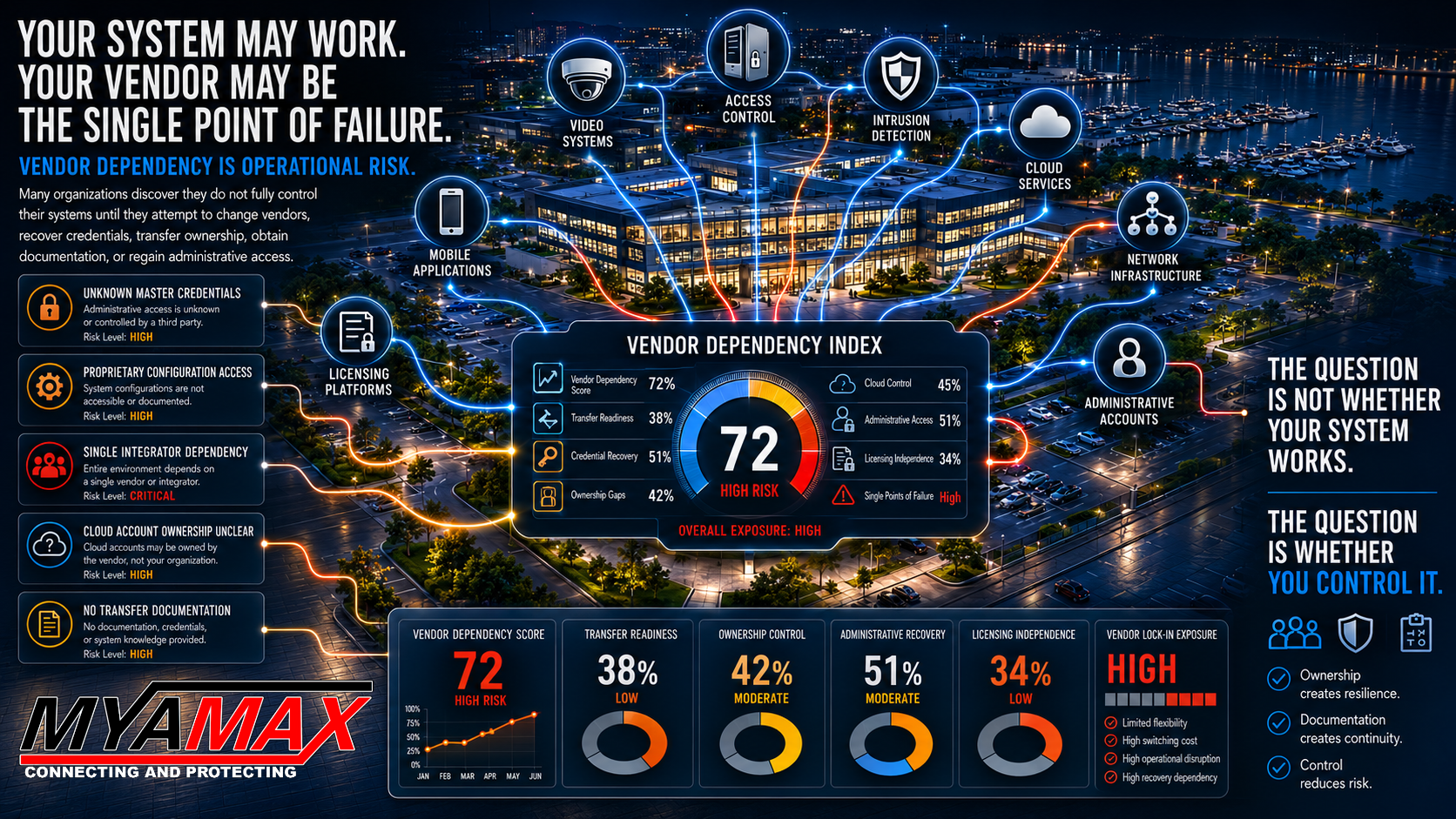
Vendor dependency is not always obvious.
A system can appear fully functional while still depending on a former installer, dealer account, cloud platform, licensing portal, or one person’s memory. The client may have a login, but that does not always mean they have operational ownership.
MYAMAX looks for the difference between visible access and true control. That includes credentials, documentation, licensing, cloud tenancy, support paths, transferability, and recovery readiness.
Common discovery moment
“We can use the system, but we cannot prove who owns the admin account, who controls the cloud tenant, or what happens if the original vendor disappears.”
The P.R.O.T.E.C.T. Report looks for control gaps, not just broken equipment.
Vendor-Controlled Accounts
Cloud portals, installer accounts, dealer accounts, remote support logins, and licensing services controlled outside the client’s authority.
Administrative Credentials
Unknown, undocumented, shared, vendor-held, or unrecoverable administrative credentials.
Licensing Control
Software, subscription, storage, support, or feature entitlements that may not be transferable or clearly owned.
Cloud Tenancy
Unclear ownership of cloud services supporting video, access control, gateways, analytics, or remote management.
Documentation Gaps
Missing as-builts, device records, IP lists, access schedules, camera maps, passwords, and configuration archives.
Support Dependency
Critical knowledge concentrated in a single vendor, technician, dealer channel, or proprietary ecosystem.
How vendor dependency usually becomes expensive.
System Works
The client sees normal operation and assumes control exists.
Need Appears
A change, failure, expansion, audit, or vendor transition occurs.
Control Gap Found
Credentials, cloud access, licensing, or documentation cannot be produced.
Emergency Cost
The organization faces delay, recovery work, replacement, or forced migration.
From vendor concern to documented business risk.
Unknown Cloud Account Ownership
Cloud services supporting the system appear to be associated with a vendor-controlled or undocumented account. Client ownership could not be verified.
Recommended action: validate tenant ownership, document recovery contacts, and confirm transfer rights.
Installer Credentials Not Documented
The system may require installer-level access for recovery, migration, or advanced configuration, but those credentials are unknown or unavailable.
Recommended action: recover or reset authorized credentials and establish controlled credential escrow.
License Transfer Unclear
Software licensing, support entitlement, or subscription ownership could not be confirmed as transferable to another vendor or client-controlled account.
Recommended action: validate license ownership, renewal status, and transfer procedures.
No Vendor Exit Strategy
No documented process exists for changing vendors without loss of configuration, access, licensing, service continuity, or support history.
Recommended action: create a vendor transition plan before service disruption forces emergency action.
Vendor dependency should be priced before it becomes a crisis.
A system rebuild, cloud transfer, emergency reset, licensing rescue, or forced migration can cost far more when discovered under pressure. The P.R.O.T.E.C.T. Report helps separate immediate risks from staged improvements and future modernization.
The goal is not to attack vendors. The goal is to make sure the client understands the relationship, owns the right layers, and can continue operating when conditions change.
Simple questions reveal deep dependency.
Vendor relationships should be useful, not controlling.
MYAMAX understands why vendors centralize platforms, accounts, licensing, and support. There are real business reasons for it. The risk appears when the client does not understand what has been centralized, who controls it, and how recovery or transfer would work.
A strong vendor relationship should still leave the client with documented ownership, authorized access, and a practical recovery path.
Core principle
Access is not ownership. A login is not a recovery plan. A vendor relationship is not a substitute for documentation.
Request a complimentary P.R.O.T.E.C.T. Report assessment.
MYAMAX helps commercial properties identify hidden vendor dependency, ownership gaps, documentation risk, licensing exposure, and continuity concerns before they become expensive.
1-888-MYAMAX-0 / 1-888-692-6290